Trump Accounts
Recently, there have been meaningful enhancements to the Trump Account Program, making it more accessible for families planning long-term savings for their children. On October 1, 2026, the U.S. Treasury announced the completion of automatic enrollment, creating Trump Accounts for more than 60 million additional eligible children without requiring parents to sign up first. Parents or guardians must still claim the accounts to manage them and enable contributions. This expansion helps make the program accessible to families who may not have been aware of the accounts or faced enrollment barriers.
It is important to note that automatic enrollment does not automatically trigger the government's one-time $1,000 contribution. Eligible U.S. citizen children born between January 1, 2025, and December 31, 2028, must have a valid Social Security number and meet the program's applicable eligibility and election requirements. Parents or guardians must claim the account and complete the necessary election to receive the contribution.
Once the account is claimed, families can contribute up to $5,000 per year in aggregate regular contributions, including qualifying employer contributions. Certain government and nonprofit contributions are treated separately from this limit. These accounts offer families another opportunity to build long-term, tax-advantaged savings for their children.
2026 Charitable Deduction Law Changes
The One Big Beautiful Bill Act has led to changes in charitable contribution deduction rules for the 2026 tax year.
Here are some of the nuances:
Taxpayers Who Itemize
0.5% AGI Floor: You can only deduct charitable contributions to the extent you exceed 0.5% of your Adjusted Gross Income (AGI). For example, if your AGI is $300,000, the first $1,500 of your donation is not deductible. This includes both cash and non-cash contributions.
60% Cap: The ceiling for cash donations to public charities is permanently set at 60% of your AGI.
Haircut for the 37% tax bracket: For earners in the 37% tax bracket, the tax benefit of itemized deductions (including charitable gifts) is effectively capped at a 35% rate. This applies to single filers with taxable income above $640,600 and joint filers above $768,700.
Carry forward: Unused contributions exceeding the 60% cap can still be carried forward for up to 5 years, provided your initial total contributions cleared the 0.5% AGI floor.
Taxpayers Who Take The Standard Deduction
Non-itemizers can now claim a permanent above-the-line deduction for cash contributions made directly to qualified public charities. The limits are as below -
Single Filers: Up to $1,000
Married Filing Jointly: Up to $2,000
How do tax brackets work?
The IRS has released the following tax brackets for the 2025 Tax Year -
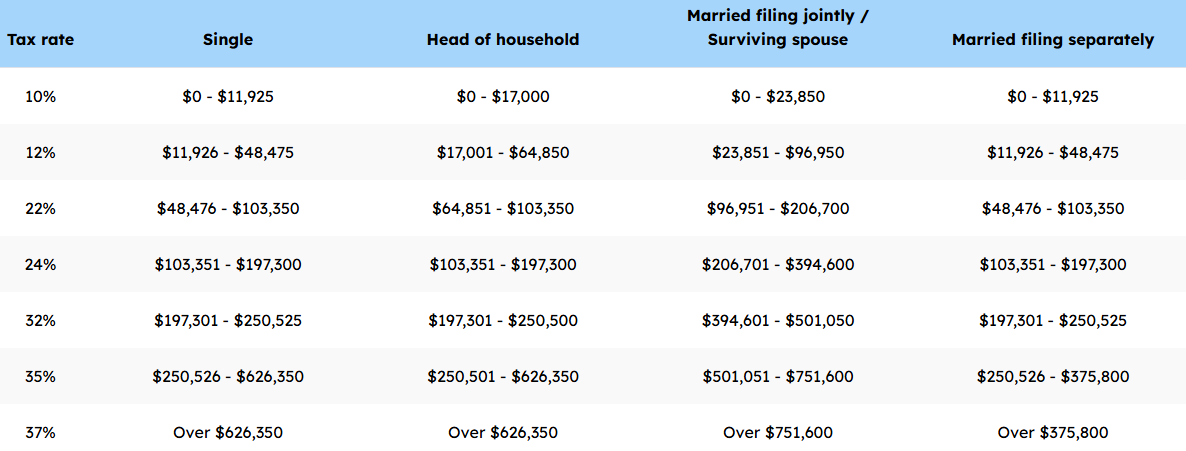
The United States operates under a progressive tax regime, which means different levels of your income get taxed at different rates. As an example, for a single filer with taxable income of $48,000, the first $11,925 will be taxed at 10%, while the remainder of the compensation will be taxed at 12%. Since the cap on the 12% threshold is $48,475, that will be the highest tax bracket this individual is subject to.
Familiarity with these brackets helps individuals get a reasonable understanding of their effective tax rate, which is the percentage of tax an individual ultimately pays the IRS.
Advantages of Health Savings Accounts (HSA)
HSA accounts have the unique distinction of being triple-tax advantaged. What exactly does that mean?
Pre-Tax or Tax-Deductible Contributions
HSA contributions reduce tax liability. If you contribute via payroll, those contributions are pre-tax contributions. Contributions made otherwise are tax-deductible.
Tax-Free Growth
Funds in HSA accounts can be invested, and any earnings in this account grow tax-free. This means no taxes on interest, dividends, and capital gains!
Tax-Free Withdrawals for Qualified Medical Expenses
Qualified withdrawals from these accounts are completely tax-free.
These characteristics make HSA accounts one of the best vehicles for growth and compounding.
Upcoming Tax Benefits for Young Families
Here are some tax benefits available to most young families for the 2025 tax year –
Child Tax Credit Expansion
This credit goes up by $200 and is now $2,200 per child, versus the previously permitted amount of $2,000.
Higher Dependent Care Flexible Spending Account (DCFSA) Limit
For many years, the IRS limited pre-tax DCFSA contributions to $5,000 annually. Beginning in 2026, that limit has been increased 50% to $7,500 annually. This change is for the 2026 tax year, but families can start making larger contributions beginning January 1, 2026.
Trump Account Tax Savings
While open to all U.S. citizens under age 18, the government has allowed every U.S. citizen born between January 1, 2025 through December 31, 2028 to receive a one-time $1,000 pilot program contribution. This amount, along with up to $5,000 of annual contributions, will be housed in a “Trump Account” and will grow in a tax-advantaged manner until the beneficiary turns 18, at which point the account converts to a traditional IRA. The opportunity to get a multi-decade head start on retirement accumulation cannot be overstated, and an election to enroll is available on 2025 tax returns!
Some Benefits of Filing Early
Tax season comes with its fair share of anxiety. Let’s be honest – it isn’t something we look forward to. But we can certainly take action to position ourselves well, and that begins with planning to file our tax returns earlier in the year.
How does expediting your tax filing help? Well, here are a few tangible benefits –
Faster Refund Processing
The IRS processes fewer tax returns earlier in the season. Filing early enables the IRS to process your refund quicker, which means you can plan for that vacation earlier, or simply invest the proceeds to build your nest egg.
Greater Personalization & Stress Reduction
Accountants have a lot of clients. This invariably means that we juggle multiple clients, as we get closer to the April 15 deadline. In submitting your documents early, you are in a scenario where you potentially have our undivided attention. This means faster communication and turnaround times. Once the tax return is filed, the last-minute rush and stress associated with the filing deadline is gone!
Fraud Protection
Tax-related identity theft has gone up over the years (The FBI has reported a 26% increase in tax related identity theft complaints from the previous year). In this scenario, a scammer could impersonate you and file “your” tax return with the intent to collect your refund. Filing early means that the IRS has a record of your return. If a fraudulent return is filed, it will be rejected.
Payment Planning
In the event you owe the IRS money, filing early helps with payment planning. If the amount is unexpectedly large, you may need some time to assess your finances and raise the amount due.
We look forward to working with you and making your tax-filing experience efficient and stress-free!